


Keeping carbon dioxide (CO2) out of the air by burning dead trees sounds a bit contradictory. Yet that's pretty much how a Helsinki company, Carbo Culture, is trying to save the climate.
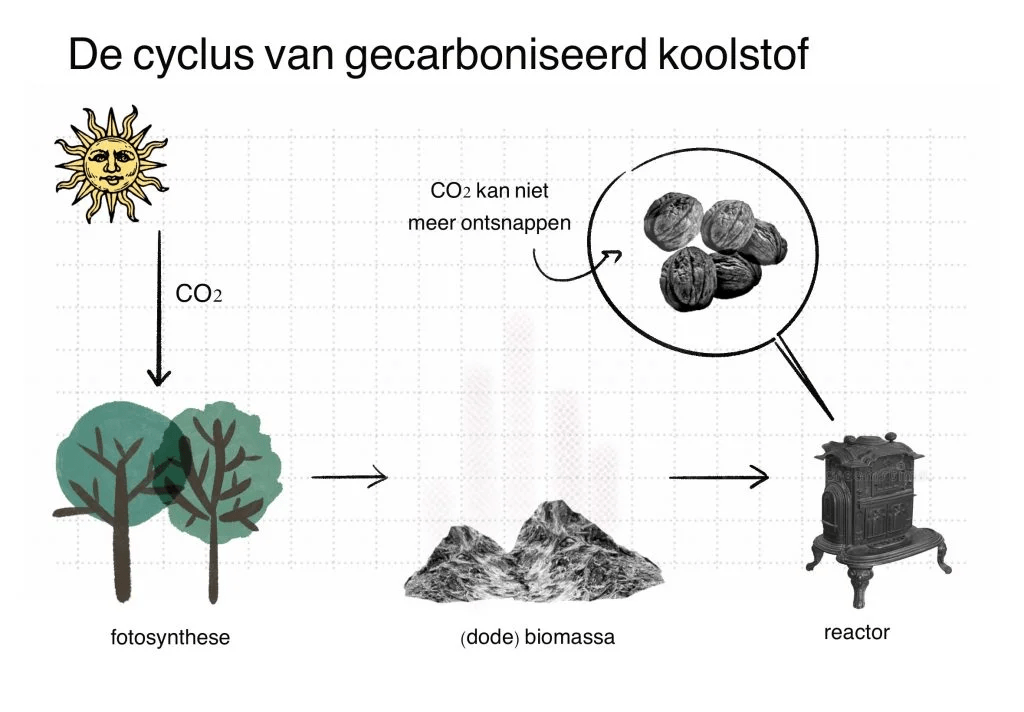
Everything that lives is made of carbon. It is also the fourth most abundant element on Earth. Every year, photosynthesis pulls tons of CO2 from the atmosphere and stores it in biomass, such as trees, crops, plantations, and so on. But when biomass dies, it decomposes and all that CO2 is released back into the atmosphere. That is the natural cycle of carbon.
The company Carbo Culture has found a way to apply that process without releasing CO2 again. They put dead biomass, such as empty walnuts or dead wood, in a reactor that can quickly be brought to an immensely high temperature. The reactor burns the biomass for a fraction of a second at 1000 degrees Celsius. In this way, the dead biomass carbonizes and a kind of ball of charcoal remains.
It is sturdy, it does not decompose, it is not eaten by microbes and it can be stored safely. In this way, that charcoal-like ball, which is almost pure carbon, remains stable for about a thousand years. You can then safely throw it in the compost, bury it or even filter water with it.
The entire process uses less than 4 percent of the energy source and takes two hours to carbonize half a ton of carbon.
Carbo Culture recently raised 6,2 million euros in seed capital, but many investments are still needed to bring the process to a global scale. Investments will be needed from both private and public sectors to save the climate. Or more similar companies. Carbo Culture welcomes competition and whatever it takes to get rid of that excess CO2.
CO2 emissions continue to rise
And there is still a lot of work to be done. In January last year, the concentration of CO2 in the atmosphere was measured in Hawaii and it was never so high. We are breaking record after record, and although the pandemic seemed to provide some relief for a while, it does not solve our problem. CO2 emissions will most likely rise again in Belgium. This is due to the planned closure of nuclear power stations. Emissions are expected to be about twelve percent higher in 2026 than they are now. (am)